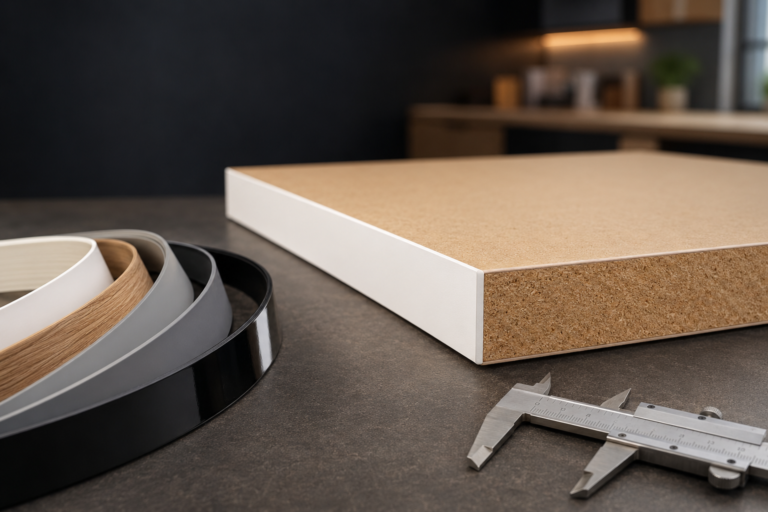
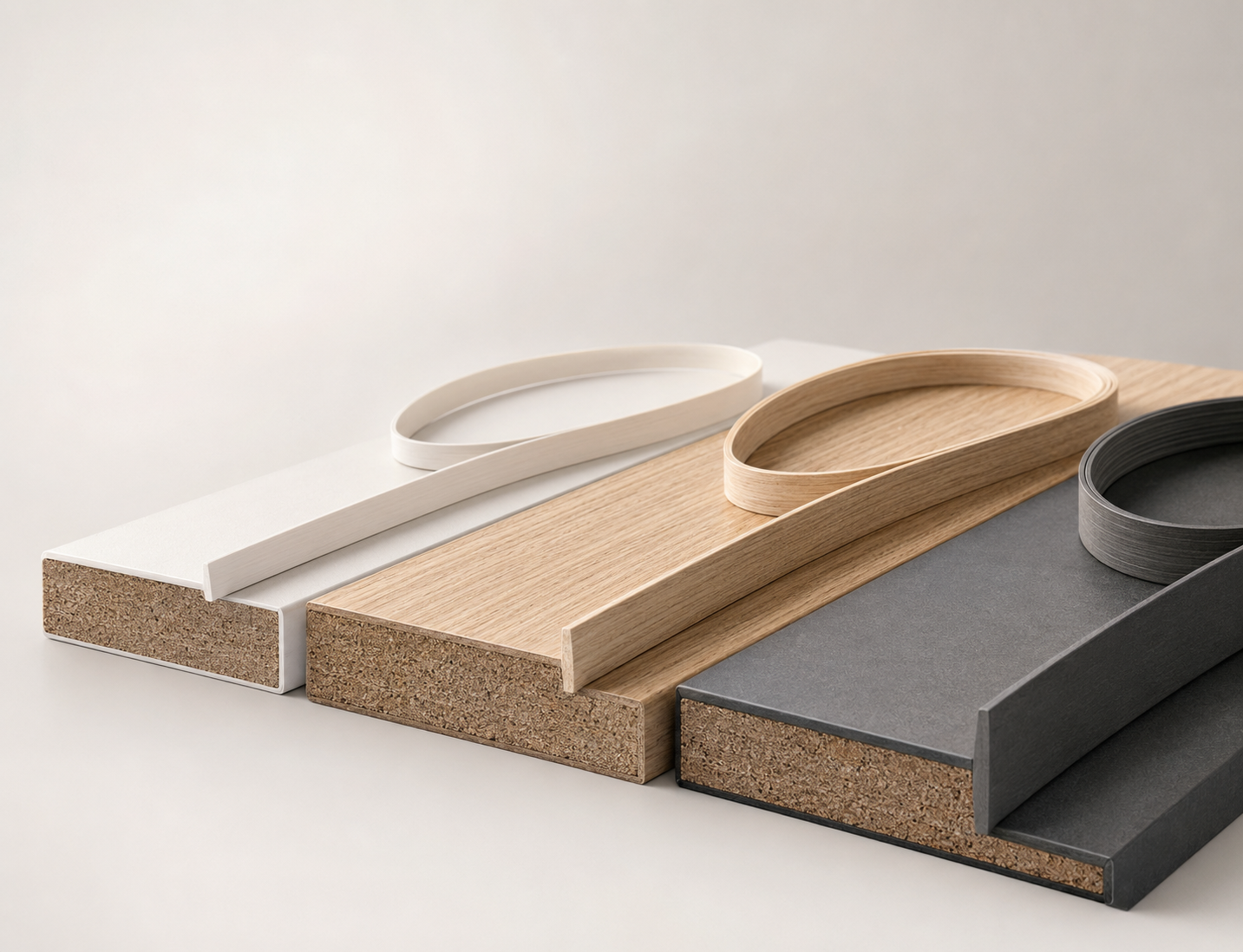

Choosing the right PVC edge banding thickness affects the appearance, durability, cost, and production efficiency of furniture. For cabinet makers, furniture factories, and panel wholesalers, the best choice depends on where the panel will be used, how often the edge will be touched or impacted, and the appearance required.
As a PVC edge banding manufacturer in China, Hengsu supplies customised PVC edging solutions for MDF, particle board, plywood, melamine panels, cabinets, wardrobes, office furniture, and other panel-furniture applications. This guide explains how to choose the right thickness for your project.
What Does PVC Edge Banding Thickness Mean?
PVC edge banding thickness is the measurement from the adhesive side to the visible outer surface of the edging strip. It is normally measured in millimetres.
Common options include:
- 0.4–0.6 mm: Thin PVC edge banding for internal or lower-impact furniture parts
- 0.8–1.0 mm: A versatile option for general cabinet and furniture production
- 1.5–2.0 mm: Thicker edging for visible, high-contact or higher-durability edges
- 3.0 mm and above: Used for selected heavy-duty furniture designs or special edge profiles
The correct thickness should be considered together with width, colour, texture, panel material, edge banding machine, adhesive, and end-use conditions.
0.4–0.6 mm PVC Edge Banding: A Cost-Efficient Choice
Thin PVC edge banding is often selected for internal furniture components and surfaces that receive less direct contact. It can be suitable for cabinet interiors, drawer sides, back panels, shelving interiors, and economical furniture ranges.
This thickness is popular when manufacturers need a neat finished edge while controlling material costs. It can also work well for large-volume production where consistency and efficiency are important.
However, thin edging provides less impact protection than thicker options. For exposed cabinet doors, table edges, wardrobe fronts, or commercial furniture, a thicker PVC lipping may offer better long-term resistance to knocks and daily wear.
0.8–1.0 mm PVC Edge Banding: The Everyday Furniture Standard
For many furniture manufacturers, 0.8 mm or 1.0 mm PVC edge banding is a practical balance between cost, appearance, and durability.
It is commonly used for:
- Kitchen cabinets
- Wardrobes
- Office desks
- Storage furniture
- Melamine-board furniture
- MDF and particle-board panels
- Retail and residential furniture
This thickness can provide a more substantial finished feel than thin edging while remaining suitable for efficient machine application. It is especially useful for furniture edges that are visible and frequently handled but do not require heavy impact protection.
When sourcing 0.8 mm or 1.0 mm PVC edge banding, buyers should confirm the required width, finish, colour matching standard, roll length, and whether the product will be used with EVA hot melt glue or another adhesive system.
1.5–2.0 mm PVC Edge Banding: Better Protection for Visible Edges
Thicker PVC edge banding is often chosen for furniture with prominent, exposed edges. It creates a stronger visual line around the panel and can provide improved protection from everyday bumps.
Typical applications include:
- Kitchen cabinet doors and visible side panels
- Wardrobe doors
- Tabletops and desks
- Commercial counters
- Children’s furniture
- School or office furniture
- Display furniture
- High-contact shelving and storage units
A 1.5 mm or 2.0 mm PVC edge banding is a strong choice when the furniture needs a more durable edge appearance. It can also enhance the perceived quality of the finished product, especially on matte, wood-grain, embossed, high-gloss, or solid-colour panels.
Thicker edge banding may require careful adjustment of trimming, scraping, buffing, and adhesive settings on the edge banding machine. Always test the selected edging with the actual board and production equipment before full-scale production.
How to Choose Thickness by Furniture Application
The easiest way to select PVC edge banding thickness is to begin with the furniture application.
| Furniture Area | Typical Thickness Direction | Main Consideration |
|---|---|---|
| Internal cabinet components | 0.4–0.6 mm | Cost control and neat finishing |
| Standard shelves and storage units | 0.8–1.0 mm | Everyday durability |
| Kitchen cabinets and wardrobes | 0.8–2.0 mm | Visibility and frequency of use |
| Desks and tabletops | 1.0–2.0 mm | Edge impact and user contact |
| Commercial or high-use furniture | 1.5–2.0 mm | Stronger edge protection |
| Special profiles or heavy-duty designs | 3.0 mm+ | Design and technical requirements |
These ranges are general selection guidelines. The final choice should be based on panel design, furniture use, local market expectations, and machine compatibility.
Thickness Is Not the Only Specification That Matters
PVC edge banding thickness alone does not determine the final quality. Buyers should also check:
Width
The edging width must fully cover the panel thickness while allowing enough extra material for trimming. For example, 19 mm, 22 mm, and 42 mm widths are commonly selected according to the board specification and finished-edge requirement.
Colour and Texture Matching
For melamine-faced boards, MDF, particle board, or wood-grain furniture panels, accurate colour matching is essential. A thickness choice should also match the required finish, including matte, gloss, embossed, wood grain, or textured surfaces.
Adhesive Compatibility
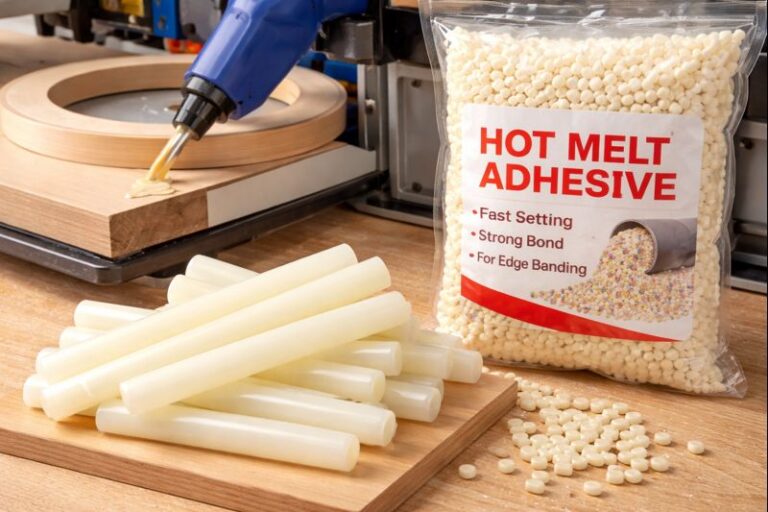
PVC edge banding is commonly applied with hot melt adhesive. Adhesive selection, machine temperature, feed speed, pressure, and ambient conditions can all affect bonding performance. The adhesive supplier and machine operator should confirm suitable working parameters for the specific PVC edge banding and board material.
Panel Type and Edge Preparation
MDF, particle board, plywood, and melamine panels may require different edge-preparation attention. Clean, straight, dust-free board edges help achieve a more stable and attractive bond.
Custom PVC Edge Banding from Hengsu
Hengsu is a custom edge banding supplier in China for furniture manufacturers, cabinet makers, distributors, and panel wholesalers. We can support customised PVC edge banding requirements including thickness, width, colour, wood-grain pattern, texture, matte or gloss finish, and packaging.
Whether you need thin PVC lipping for cost-effective furniture production or thicker PVC edging for visible cabinet and wardrobe edges, selecting the right specification before production can reduce waste, improve consistency, and strengthen the final product appearance.
Contact Hengsu with your board sample, colour reference, thickness, width, and application details to discuss a suitable PVC edge banding solution.
Frequently Asked Questions
What is the most common PVC edge banding thickness?
For general furniture and cabinet production, 0.8 mm and 1.0 mm are widely used because they balance cost, appearance, and everyday durability.
Is 2 mm PVC edge banding better than 0.8 mm?
Not always. A 2 mm edging is generally more suitable for exposed or high-contact edges, while 0.8 mm may be more cost-efficient for standard furniture applications. The best option depends on the panel location and furniture use.
What thickness of PVC lipping is suitable for MDF?
MDF furniture can use different thicknesses depending on the application. Thin edging may suit internal panels, while 0.8–2.0 mm options are often selected for visible cabinet, wardrobe, desk, or tabletop edges.
Can PVC edge banding be customised?
Yes. A professional PVC edge banding manufacturer can customise thickness, width, colour, texture, wood-grain pattern, finish, and packaging according to the customer’s panel and market requirements.